 Oculista Bolzano

A brief flash at the side in a dark room
People describe a small lightning bolt, camera flash or bright bracket at the edge of vision. It may recur with eye movement or when going to bed. The term photopsia means a sensation of light that can occur without an external light source.
Darkness increases contrast. Noticing it only in the evening does not establish tiredness as the cause. Even one new flash clearly arising in one eye is a reason to contact an ophthalmologist the same day. Absence of pain, redness or floaters does not exclude a retinal problem.
If a shadow appears, part of the scene is missing or vision decreases, the problem is no longer an isolated flash. Go straight to the emergency department. Do the same for a shower of new pepper-like or soot-like dots, even if you can still read.
How vitreous movement can produce light
The retina converts light into signals interpreted as images by the brain. Mechanical stimulation can also be perceived as light. The transparent vitreous gel may pull on the retina as it separates, and a brief tug can feel like an arc or flash.
Separation often finishes with an intact retina. Sometimes a stronger attachment pulls enough to cause a tear. Similar flashes can occur in either situation. Brightness and number of flashes alone cannot determine whether damage is present.
A tear matters even before detachment develops. If vitreous fluid passes through it and collects beneath the retina, the retina may lift. Identifying and treating an appropriate tear before that happens can reduce the risk.
An instant flash or an expanding zigzag?
A brief peripheral flash recurring in one eye can fit vitreoretinal traction. Some migraine auras instead appear as a jagged or shimmering border that expands and changes position over minutes, sometimes enclosing an area of reduced vision. Headache may follow or be absent.
Typical visual aura originates in the brain’s visual pathways. It can affect the same side of the scene in both eyes and be mistaken for a one-eye symptom. If safe and without delaying care, covering one eye then the other without pressure may help describe whether the pattern remains with either eye. Report the observation rather than trying to diagnose it yourself.
A first episode, changed pattern or truly one-eye phenomenon merits assessment. Sudden reduced vision, a darkened area, speech difficulty, facial drooping, weakness or imbalance needs immediate help. Call 112 for possible stroke signs.
Details that help the assessment
Report onset, how many seconds or minutes each episode lasts, whether it is central or peripheral and whether vision otherwise remains normal. Give the timing of any injury or operation. Mention previous retinal detachment or tears and which eye was affected.
A useful example is: “Since yesterday evening I see a side arc lasting less than a second, repeatedly. This morning I also noticed new threads.” You do not need to know which retinal area is involved or photograph the flash. Note timing if possible, but do not delay care to collect more episodes.
After surgery, impact or eye movement
After cataract surgery, some people notice reflections, arcs or halos related to light from the side. The implant may contribute to these optical effects. Contact the operating team for a new symptom and explain whether it occurs under certain lamps or also in darkness. New dots, a curtain or reduced vision requires urgent assessment. An arc’s shape alone cannot confirm an implant-related effect.
After an eye or head impact, the mechanism and timing guide care. A flash immediately after injury, especially with visual change, should not be assumed harmless. Significant trauma, a wound or a high-speed object requires emergency assessment even without visible bruising.
Flashes reproduced by eye movement may fit retinal traction but do not establish a tear. Avoid repeatedly provoking them. The important information is whether they are new, whether other symptoms have appeared and when the pattern changed.
When flashes start outside normal opening hours
Seek same-day urgent ophthalmic contact for a new episode. If no clinician is available, use the emergency department. Say it is a new visual symptom even if the flash has stopped at that moment. A curtain or reduced vision needs immediate assessment. Arrange an escort if vision has changed or dilation is likely.
For previously assessed flashes under an existing plan, compare with your usual pattern. “The same brief light with no other change” differs from “It happens much more often and there are new dots.” Changed symptoms warrant earlier contact with the assessing team or emergency service according to severity.
The examination needed to look for a tear
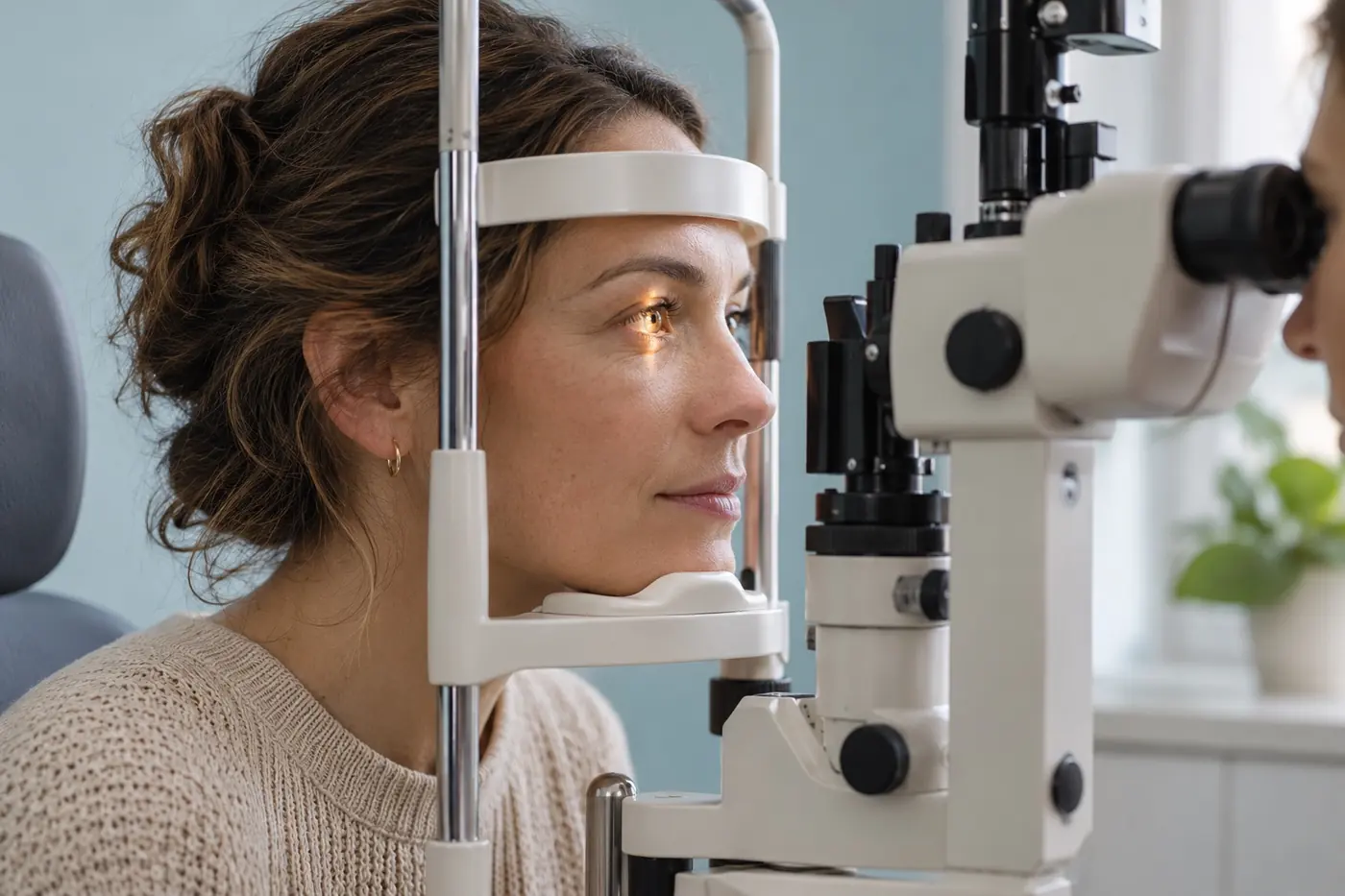
The ophthalmologist checks vision and looks for traction, pigment or blood in the vitreous. A dilated examination includes the peripheral retina, where tears may lie outside the central area. Reading an eye chart well does not complete this assessment.
Photographs or central OCT can add information when indicated, but the far peripheral retina still needs appropriate examination. Ultrasound and repeat assessment may be needed if the view is obscured. Expect dilation to interfere with driving for several hours in some people.
If flashes stop or the first examination is normal
Flashes stopping before the appointment does not prove that the retina is intact. A recent first episode still needs examination. After an intact retinal assessment, the clinician may schedule review according to findings and how well the peripheral retina was seen.
Delayed tears have been documented after an initial examination. Report more frequent flashes, new floaters, a shadow or reduced vision immediately. Give the first examination’s result and the timing of the change. If symptoms stay stable, follow the agreed review schedule.
Laser for a retinal tear: what it protects
For a tear requiring treatment, laser creates an adhesion barrier around the lesion; cryotherapy may be used in other circumstances. The aim is to limit fluid passing under the retina and reduce detachment risk. Tear type, traction, surrounding fluid and the eye’s condition guide the choice.
Treatment does not “glue the vitreous down” or automatically eliminate flashes and floaters. The vitreous can continue changing. Some persisting flashes do not alone prove treatment failure; equally, their disappearance does not prove that no other lesion can develop. Follow-up checks the treated area and remaining retina.
Before discharge, ask about timing and activity limits for your case. Adhesion should not be regarded as instant or absolute protection. A curtain, reduced vision or many new dots requires immediate reassessment even after laser. State the eye, procedure date and changed symptom.
Sources · AAO – Floaters and flashes · AAO – Preferred Practice Pattern, 2025
All sources and further reading (12)
- National Eye Institute – Retinal detachment
- International Headache Society – ICHD-3
- NICE CG150 – Headaches
- Ministero della Salute – Ictus e TIA
- Royal College of Ophthalmologists – About eye health
- American Academy of Ophthalmology – Cataract surgery side effects
- NHS – Eye injuries
- Azienda Sanitaria dell’Alto Adige – Oculistica di Bolzano
- Nixon et al. – Eye, 2024
- Ophthalmology Retina – IRIS Registry, 2023
Illustrative images from the website’s image library.
- AI-generated illustrative image
- AI-generated illustrative image