 Oculista Bolzano

First question: loose dust or a high-speed fragment?
If light dust blew in on the wind and there are no signs of injury, gentle rinsing with clean water or sterile solution may help. Grinding, hammering metal, cutting material or using a lawnmower can project a particle at high speed, even if you felt only a slight prick. Go straight to the emergency department and explain the mechanism.
With a wound, sharp object or embedded fragment, do not try to remove or move it. Do not press on the eye or apply a tight dressing. Do not drive with altered vision; call 112 if emergency assistance is needed. Chemical splashes require a different first step: begin rinsing immediately while arranging help.
Rinsing a loose surface particle
Wash your hands and use a gentle flow of clean water at a comfortable temperature. Do not direct a forceful jet onto the cornea. Let tears and water carry material away. Avoid rubbing, nails, tissues on the cornea, cotton buds and tweezers. Discomfort may decrease substantially when a loose particle washes out.
If the foreign-body sensation persists, stop repeated attempts to find it yourself. A particle may be under the eyelid or have scratched the cornea. Persistent pain, substantial watering, photophobia or reduced vision needs urgent assessment. With unusual irritation during contact lens wear, do not reinsert lenses and seek immediate advice. Never use the rinse water to clean contact lenses.
Why it can still feel scratched after the particle is gone
The front of the cornea has many sensitive nerve endings. Even a small surface abrasion can make every blink painful and feel like a grain is still present. Alternatively, a particle may remain under the upper lid and continue to rub. It is not always visible in a mirror.
Report the previous injury if pain returns on waking days or months later. A healed surface can sometimes reopen in a small area. Describe the sequence: first a grain was felt, rinsing removed something, then stinging continued. Worsening vision or inability to open the eye should not be left to settle on its own.
Removal and corneal examination
The examination considers the material and its speed. When safe, the clinician checks vision, examines the cornea under magnification and may use dye to show a scratch. They may inspect beneath the lid or remove a superficial foreign body. Some metallic particles leave deposits needing specialist assessment. Possible penetration requires a different investigation pathway.
Report attempts at removal, any drops already used and whether the material was metal, wood or glass. Be candid about protective eyewear; this helps establish how contact occurred. Mention previous eye surgery and its date even if it seems unrelated.
Follow-up and preventing another episode
After treatment for a scratch, ask when contact lenses may resume and whether the cornea needs rechecking. Return sooner for increasing pain, redness, discharge, light sensitivity or worse vision. Mild residual discomfort can accompany healing, but its course should match the instructions you received. Do not mask new pain with leftover anaesthetic drops.
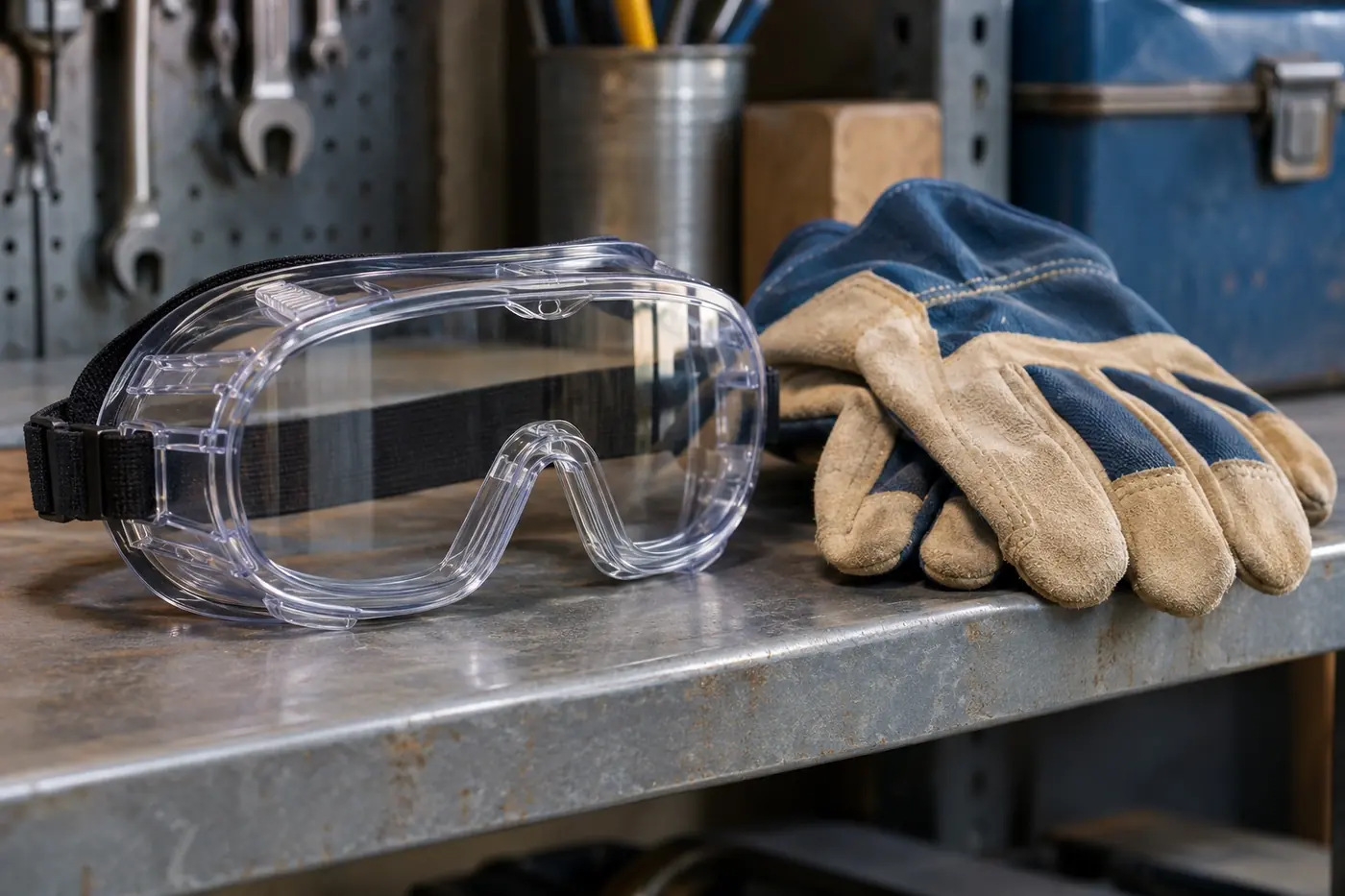
For future work, choose eye protection appropriate to the task, including particles arriving from the side. Ordinary prescription glasses are not necessarily designed to withstand impact. Protect bystanders too: fragments can reach someone watching as well as the person using a tool.
Metal fragments and rust rings after removal
A superficial metal fragment may leave a small rust deposit in the cornea. The clinician decides whether and how to remove it and whether another procedure or review is needed. Do not scrape a remaining dot: you could enlarge the injury or create a scar in the visual axis.
Removal may leave an abrasion, a defect in the cornea’s outermost layer. Burning therefore need not disappear the instant the fragment comes out. Treatment and follow-up depend on location, extent and infection risk. Increasing pain or redness, deteriorating vision or a whitish area requires prompt reassessment.
A high-speed fragment raises another question: whether it has penetrated beyond the surface. A tiny entry point or reduced pain does not exclude this. Always name the tool and say whether metal struck metal. This information guides care more reliably than relief after an initial rinse.
Sources · NHS – Eye injuries · AAO · Recognizing and treating eye injuries
All sources and further reading (6)
- Moorfields Eye Hospital – Corneal foreign body
- The Princess Alexandra Hospital NHS – Corneal abrasion
- Manchester Royal Eye Hospital – Recurrent corneal erosion
- Moorfields Eye Hospital · Ocular foreign body
Illustrative images from the website’s image library.
- Mikhail Nilov · Pexels License
- AI-generated illustrative image