 Oculista Bolzano
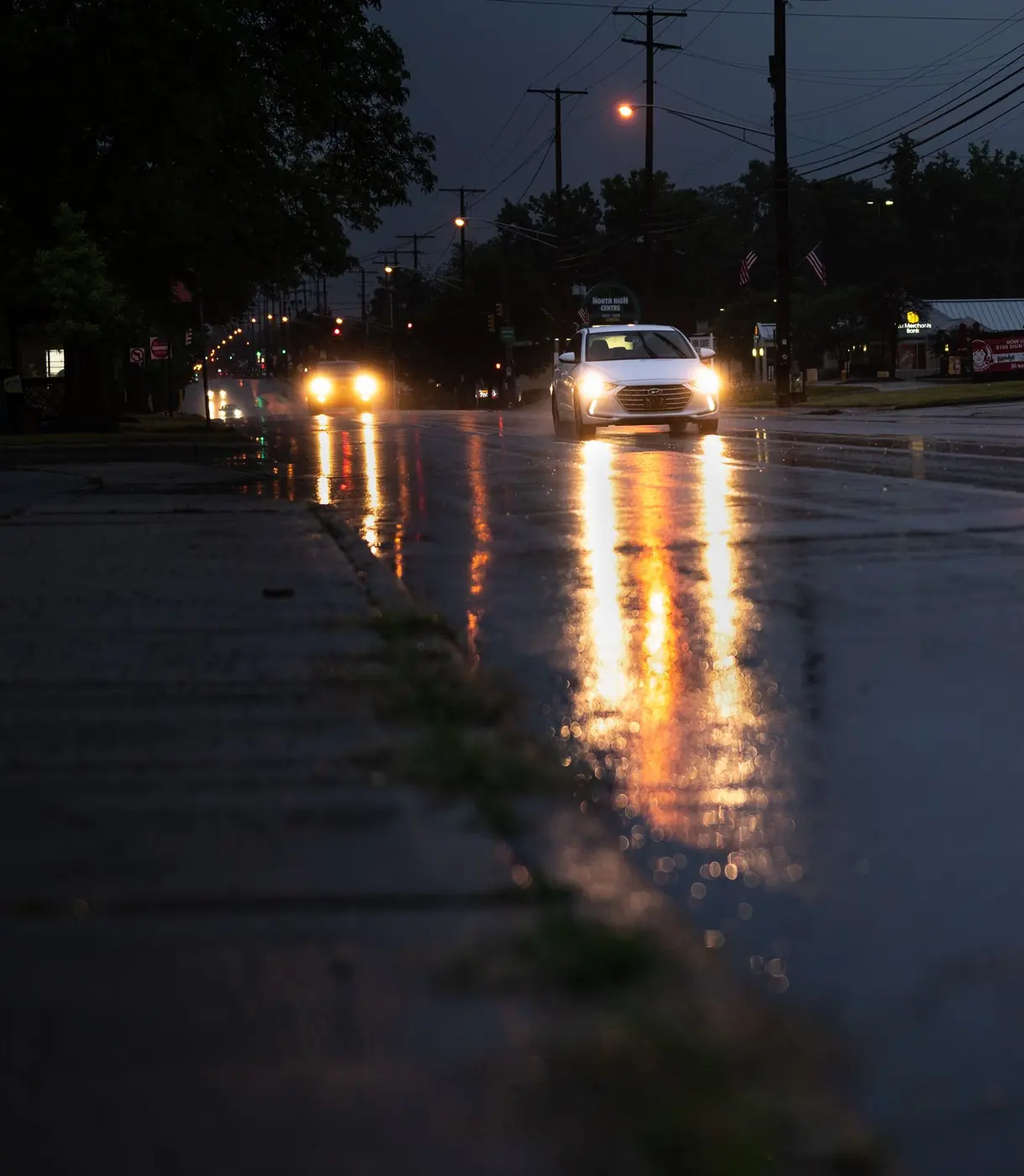
The first decision: can you drive safely?
If each headlight leaves you struggling to recognise the road, or you lose sight of pedestrians and cyclists, arrange an alternative to night driving until assessed. If the problem develops while driving and compromises your view, slow down and stop somewhere safe. Explain whether it happens only with headlights, also with street lamps or with every light at home.
Sudden halos with severe pain, a red eye, blurred vision or nausea require immediate assessment. An acute rise in eye pressure is among the conditions that need excluding in this situation. Do not drive yourself to the emergency department. A major sudden loss of vision or other emergency signs warrants a call to 112.
Halos, glare and flashes are different descriptions
A halo is a ring or glow around a light source such as a headlight. It may have rays or a blurred edge. Glare is difficulty seeing surrounding objects because a source is bright. A new flash at the side of your vision without an external light source is a different symptom. That can require retinal assessment, particularly with new dots or a shadow.
Use concrete examples. “There is a ring around the headlight, but I can read nearby signs” differs from “For a moment I cannot see the pavement.” When safely stationary, you can note whether the effect remains with each eye separately. A disturbance may be stronger on one side and affect the combined view.
How glasses and the eye surface may contribute
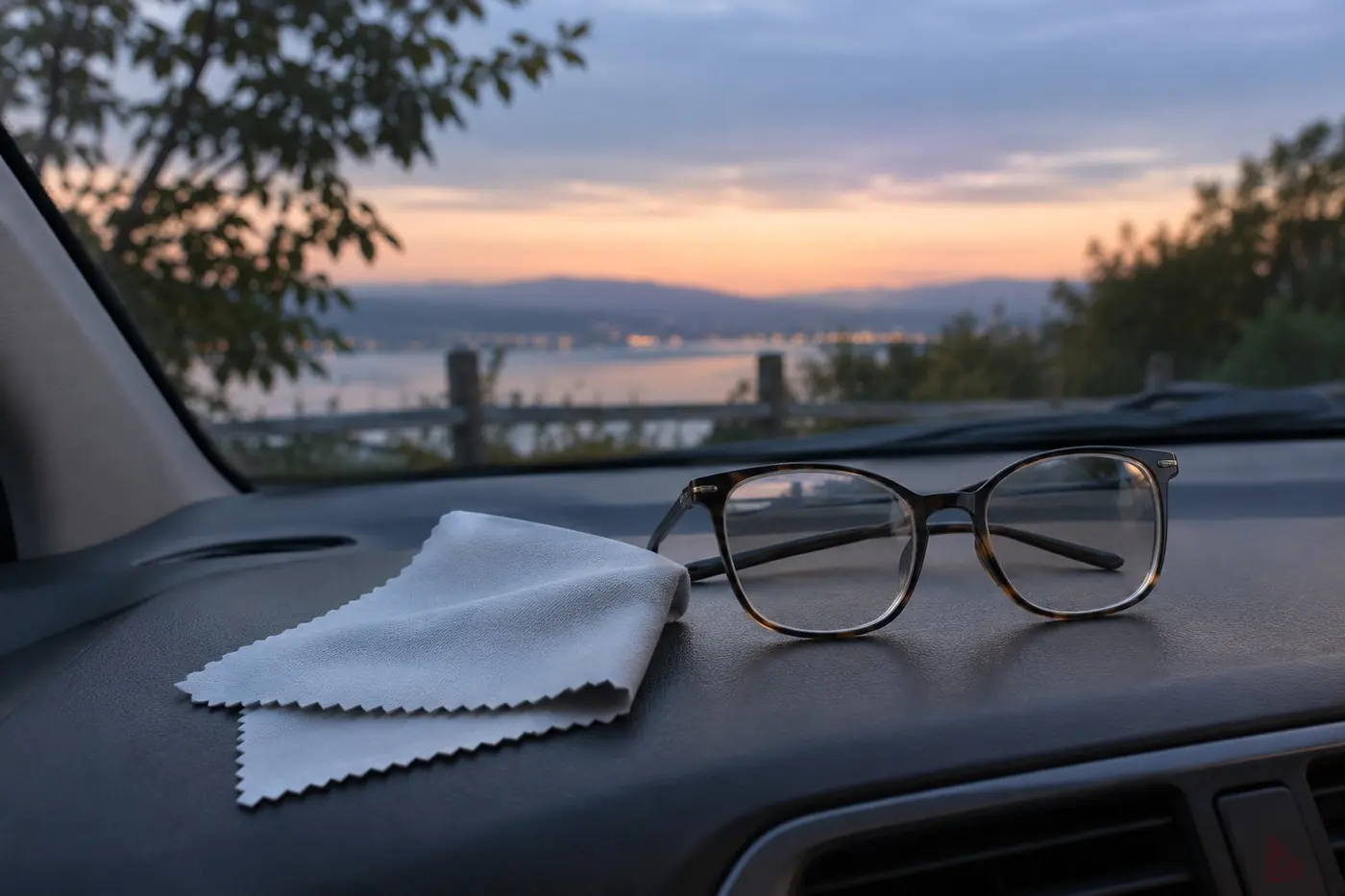
An outdated prescription can reduce clarity in dim conditions. Scratched or dirty lenses and windscreen reflections also make the scene harder to see. Start by cleaning what you look through and note whether halos also occur at home with your usual glasses. An uneven ocular surface can scatter light. Mention if a blink briefly reduces a halo.
These observations help guide the examination. They do not establish whether drops, different lenses or another treatment will be sufficient. Avoid dark lenses to mask the effect at night. The practical issue is how well you see obstacles; reducing the available light further does not correct the cause of poor visibility.
When cataract contributes to glare
As the natural lens becomes cloudy, light may scatter and contrast can fall. You may still read many letters on a daytime chart while struggling in dim light. Halos, less vivid colours and gradual visual change are useful details to report. Whether to operate is discussed in relation to the effect on daily life and the rest of the eye examination.
After cataract surgery, some people notice halos or arcs under particular lighting. The artificial lens and other changes may contribute. Worsening vision, increasing pain or increasing redness after surgery instead calls for urgent contact with the operating team. If blur returns gradually months or years later, the ophthalmologist can also assess the posterior capsule.
Preparing for your appointment
Bring the glasses you use for driving. Explain when glare began, whether it is worsening and whether you have reduced evening activities. Describe one or both eyes being affected and how long the difficulty lasts after the light source has passed. Mention changes while reading, looking at screens or following surgery.
The ophthalmologist may assess your prescription, cornea, lens and retina. Suspected pressure problems guide further examination. New glasses can help when focus explains the difficulty, but may not resolve a problem from another cause. Ask how to judge everyday improvement before resuming activities that currently feel unsafe.
Contrast and glare: beyond the eye-chart score
A clinic chart commonly uses dark letters on a bright background. An evening road combines bright headlights with dark areas and less distinct edges. Good chart acuity can coexist with difficulty seeing a kerb in that setting. Contrast sensitivity describes the ability to distinguish a detail from its background when the difference is small. Describing the setting helps guide assessment even if you read the chart well.
A photograph or example may help explain the difficulty. More useful still is naming the obstacle and situation, such as a crossing when an oncoming vehicle approaches. Recall whether the problem also occurs as a passenger or when looking at a light while stationary. Do not recreate the difficulty as a test while driving.
Why it can be more noticeable at night
In darkness the pupil widens to admit more light. A bright headlight also stands out strongly against a dark background. Small imperfections in focus or the transparency of the eye’s optical structures may become more troublesome than in a well-lit room. This explains why symptoms can be real despite good daytime reading.
Clean lenses and suitable correction may improve the optical part of the problem. They do not necessarily remove light scatter caused by cataract or an irregular cornea. If you have an intraocular lens, report its type if known and whether halos started immediately after surgery or developed later. Timing helps distinguish different possibilities.
Do not judge driving safety by the chart score alone. You need to recognise pedestrians, the road edge and obstacles in time after glare. Until the problem is clarified, arrange someone else to drive or travel in daylight. Dark glasses at night reduce available light further and do not resolve the underlying cause.
Sources · National Eye Institute – Cataracts · National Eye Institute – Angle-closure glaucoma
All sources and further reading (10)
- NHS – Red eye
- American Academy of Ophthalmology – Cataract surgery side effects
- AAO – Floaters and flashes
- National Eye Institute · Eyeglasses for refractive errors
- TFOS Lifestyle – Digital environment, 2023
- TFOS DEWS III – Diagnostic Methodology, 2025
- Cambridge University Hospitals · YAG laser capsulotomy
- Contrast and driving difficulty after first-eye cataract surgery, 2013
Illustrative images from the website’s image library.
- Chris F · Pexels License
- AI-generated illustrative image