 Oculista Bolzano

When not to wait
An eye that becomes red and genuinely painful needs urgent examination. If vision worsens, light makes it difficult to keep the eye open, pain is severe or you have nausea and halos, go straight to the emergency department. Call 112 for a major loss of vision or if emergency assistance is needed. Do not drive with altered vision.
Report a blow, a high-speed fragment or a chemical exposure immediately because it changes the first action. Start rinsing at once after a chemical splash; if an object is embedded, do not press on the eye or try to remove it. After eye surgery or an injection, pain, increasing redness or worsening vision requires immediate contact with the treating centre.
Burning, itching and pain: describe the difference
Diffuse burning or grittiness can accompany irritation and conjunctivitis. Predominant itching, especially in both eyes, can suggest allergy. Deep, throbbing or difficult-to-tolerate pain, or painful light sensitivity, should not be labelled conjunctivitis without an examination. Even a small corneal scratch can be intensely painful.
Notice whether vision remains blurred after gently clearing any discharge and blinking. This cannot rule out a serious problem, but it is useful information when requesting help. “Does light make the pain worse?” and “Can I read less than usual with one eye?” are more informative than judging redness alone.
The cornea and contact lenses
Keratitis means inflammation of the cornea and is sometimes caused by infection. Pain, redness, watering, light sensitivity or reduced clarity requires examination, particularly in contact lens wearers. Remove ordinary lenses if this is easy and do not reinsert them. Even initially modest new discomfort may need immediate assessment when associated with contact lens use.
Report sleeping, swimming or showering in lenses and any change in solution or cleaning routine. Do not rinse lenses with water or reuse old antibiotic or steroid drops. Treatment depends on what is found on the cornea. Drops used for a previous problem may be unsuitable or alter the clinical picture.
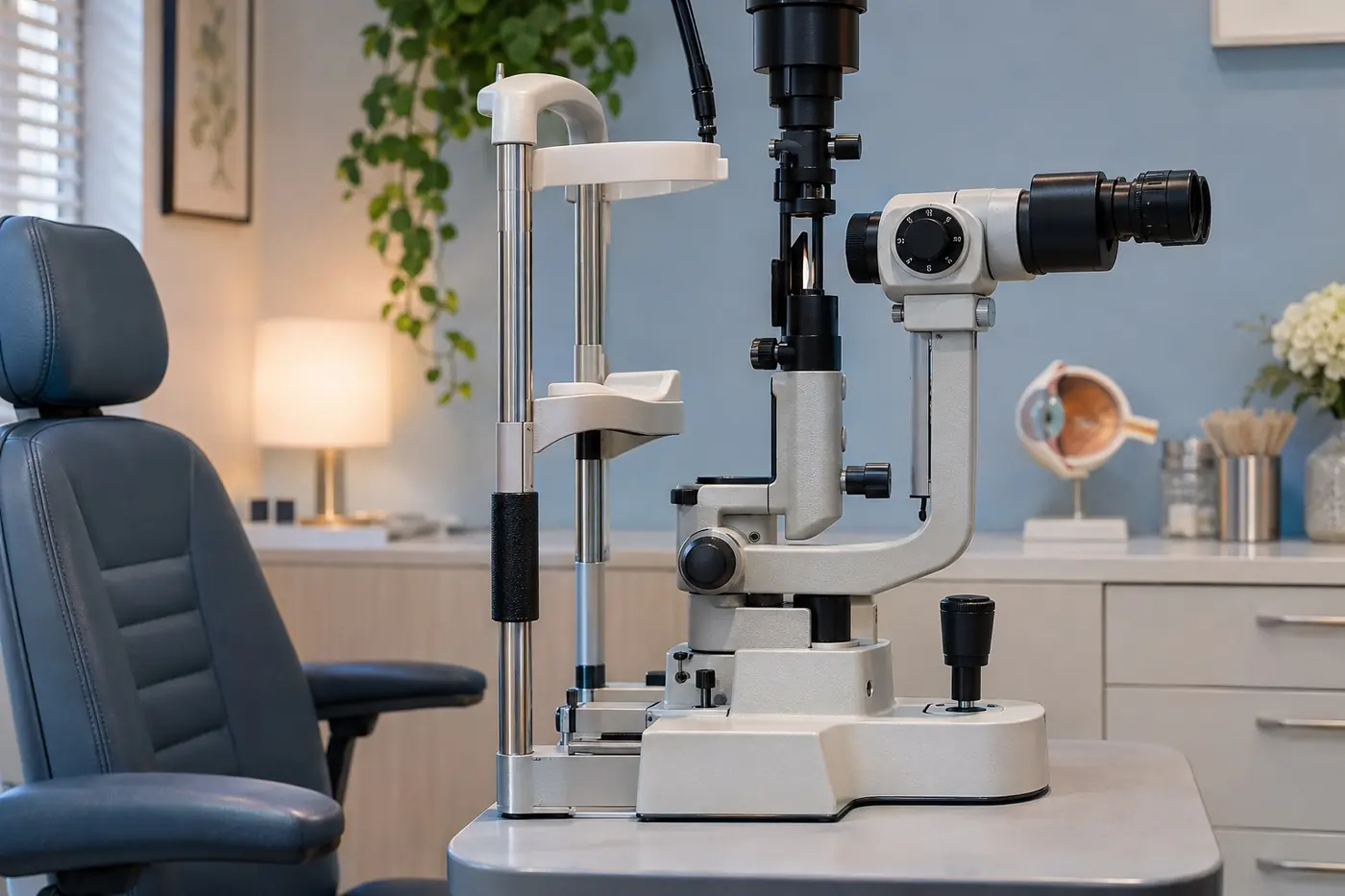
Uveitis and acute angle closure: conditions to exclude
Uveitis can cause pain, sensitivity to light and blurred vision. The ophthalmologist looks for inflammation using a slit lamp. Even if you have had previous episodes, describe new symptoms. Treatment depends on the location and cause, so do not independently restart drops from an earlier episode.
In acute angle-closure glaucoma, pressure inside the eye can rise quickly. Alongside pain and redness, there may be halos, headache, blurred vision and nausea. Do not wait for every sign to appear. Diagnosis requires an in-person examination, with pressure measured when appropriate. Blood pressure measured at your arm does not tell you the pressure inside your eye.
What happens during the examination
Assessment starts with when symptoms began and how vision changed. The clinician examines the cornea, conjunctiva, pupil and front structures of the eye. A dye can reveal a scratch or surface defect. Pressure measurement or retinal examination may follow depending on the findings. After trauma, some tests are performed only once an open injury to the eye has been excluded.
You do not need to know which structure hurts. Describe how long it has hurt and whether removing a lens or exposure to a substance changed the symptoms. Bring the names of medicines and drops used, and the date and centre for any recent surgery. Tell staff immediately if vision worsens while waiting.
Why “red-eye drops” may be the wrong treatment
Redness is a response of surface blood vessels, not a diagnosis. Making the eye look less red does not establish that the cause has been treated. Vasoconstrictor drops may temporarily whiten the eye, but do not treat a corneal infection, uveitis or an acute rise in eye pressure.
Antibiotics and steroids also have different purposes. An antibiotic does not cover every infection or solve a pressure problem. A steroid may be appropriate for diagnosed inflammation, but can be unsuitable in some infections or require specialist management. Similar-looking redness is not a reason to restart a leftover bottle.
Before assessment, note the product name, how often you used it and when you started. Do not indiscriminately stop regular prescribed treatment: report it and ask how to continue. If pain eases but vision worsens, emphasise the visual deterioration. That matters more than the white of the eye looking less red.
Surface pain or deeper pain: what the clinician considers
A corneal scratch may cause a sharp sensation with every blink, as though an eyelash were scraping one spot. A recurrent erosion can start when you open your eye in the morning, sometimes long after an old scratch. A small lesion may hurt intensely because the cornea has many sensitive nerve endings.
Deeper pain, sometimes worse with eye movement, leads the clinician to consider other structures too. The sensation alone cannot reliably locate the problem. Measured vision and direct examination distinguish the possibilities. Marked swelling, fever, double vision or difficulty moving the eye requires immediate assessment.
A bright-red patch on the white of the eye without pain or visual change often has a superficial origin. The distinction is useful: dramatic appearance can be less concerning than subtle redness with deteriorating vision. Describe what you feel and what you can no longer see; do not press on the eye to locate the pain.
How to judge whether the treatment plan is working
After assessment, ask which improvement is expected first: less pain, clearer vision or reduced sensitivity to light. Redness can persist while a condition improves, or fade while vision remains reduced. If an early follow-up is planned, symptom improvement does not replace checking how the eye is healing.
If several drops are prescribed, ask for written instructions showing each name, which eye and the review date. This is particularly helpful if you already use treatment for pressure or dryness. Contact the prescriber if you cannot administer the drops or run out unexpectedly. Worsening vision, increasing pain or new light sensitivity needs prompt care rather than waiting for a reply through a routine booking form.
A very swollen eyelid or pain when moving the eye
With a very swollen eyelid it may be hard to tell whether pain comes from its edge or deeper tissues. Double vision, painful eye movements, an eye that appears more prominent or reduced vision needs immediate assessment. Report fever and feeling unwell straight away. Do not press on the eye to look beneath the swelling. Say if swelling prevents you from opening it.
A photograph cannot reliably distinguish an infection confined to the eyelid from a deeper orbital infection. The clinician checks movement, vision and general health and may arrange further investigations. If these signs develop while you are already receiving treatment for a red eyelid, do not wait for the planned review. Explain what is new and when it began, even if the earlier redness seemed to be improving.
Sources · NHS – Red eye · National Eye Institute – Angle-closure glaucoma
All sources and further reading (13)
- NHS – Eye injuries
- Royal College of Ophthalmologists – About eye health
- Istituto Superiore di Sanità · Congiuntivite
- National Eye Institute · Uveitis
- CDC – Contact lens-related eye infections
- AAO · Bacterial Keratitis Preferred Practice Pattern, 2024
- The Princess Alexandra Hospital NHS – Corneal abrasion
- Manchester Royal Eye Hospital – Recurrent corneal erosion
- NHS Scotland · Orbital cellulitis in adults
- AAO · Subconjunctival hemorrhage
- NHS · Double vision
Illustrative images from the website’s image library.
- AI-generated illustrative image
- AI-generated illustrative image